Cross-Functional Operations Skills for the Modern Technology Workplace
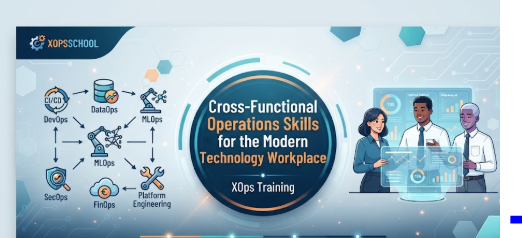
Modern technology teams rarely work in isolated silos anymore. Software developers write code, cloud engineers provision infrastructure, data engineers build pipelines, machine learning specialists deploy models, and security teams monitor vulnerabilities. As organizations scale their digital infrastructure, managing these diverse areas independently creates friction, communication gaps, and operational bottlenecks.
To solve these challenges, organizations are shifting toward a unified, collaborative mindset known as XOps. This umbrella approach connects multiple operational practices under a shared framework of automation, observability, and continuous improvement.
Platforms like XOpsSchool serve as essential learning and knowledge hubs for understanding these connected operational disciplines. By providing structured educational resources, tutorials, and courses, such platforms help learners navigate the complex landscape of modern IT operations.
What is XOps?
At its core, What is XOps is one of the most common questions asked by technology professionals transitioning into modern cloud environments. The “X” in XOps acts as a variable representing various operational disciplines, while “Ops” stands for operations. Rather than treating DevOps, DataOps, MLOps, and AIOps as completely separate technologies, XOps unifies them under common automation, governance, and feedback principles.
XOps is not a single software tool, a specific platform, or a magic formula. Instead, it is an umbrella concept and cultural mindset. It emphasizes that application delivery, data management, machine learning models, and security workflows share similar operational challenges. By applying shared principles—such as infrastructure as code, continuous integration, continuous delivery, and proactive monitoring—organizations can streamline how they build, test, deploy, and maintain digital systems.
Why XOps Matters in Modern IT
Traditional IT management often relies on fragmented teams where developers hand code over a wall to operations, data scientists build models that never reach production, and security reviews happen only at the final stage of release. This disconnection leads to slow delivery cycles, unpredictable downtime, and poor visibility into system performance.
XOps thinking addresses these challenges by encouraging:
- Automation: Reducing manual tasks across development, deployment, data pipelines, and infrastructure management.
- Collaboration: Breaking down departmental barriers between software engineers, data professionals, and system administrators.
- Observability: Maintaining deep visibility into system health, application performance, data quality, and model accuracy.
- Standardization: Using repeatable, documented workflows for every operational stage.
- Continuous Feedback: Ensuring that insights from production environments flow back into development and planning phases.
Major XOps Disciplines
Understanding XOps requires looking at the individual operational areas it connects. Each discipline targets a specific domain of modern technology.
DevOps
DevOps focuses on software delivery, CI/CD pipelines, containerization, and the collaboration between development and IT operations teams. It ensures that applications can be built, tested, and released rapidly and reliably.
DataOps
DataOps brings agile and automated practices to data engineering. It focuses on building reliable data pipelines, maintaining data quality, orchestrating workflows, and ensuring continuous data delivery for analytics and machine learning applications.
MLOps
MLOps manages the machine learning model lifecycle. It covers model development, automated testing, version control, deployment, and performance monitoring to ensure models remain accurate and reliable in production.
AIOps
AIOps applies artificial intelligence and machine learning techniques to IT operations. It helps teams analyze large volumes of monitoring data, detect anomalies, correlate alerts, and automate incident response.
SecOps
SecOps integrates security practices into every phase of the operational lifecycle, ensuring that vulnerability management, compliance, and risk assessment happen continuously rather than as an afterthought.
FinOps
FinOps introduces financial accountability into cloud operations, helping teams monitor, analyze, and optimize cloud spending without sacrificing performance or velocity.
Platform Engineering
Platform engineering builds internal developer platforms and self-service capabilities, providing standardized, reusable infrastructure and workflows for engineering teams.
XOps Training
Structured XOps Training is essential for professionals looking to transition from traditional single-domain roles into comprehensive operational engineering. A well-designed learning path typically covers foundational software delivery, cloud infrastructure, automation scripts, container orchestration, and monitoring.
Rather than focusing on isolated tools, effective training emphasizes how different operational domains interact. For example, learners study how application code interacts with underlying infrastructure, how data flows through pipelines into machine learning models, and how observability tools track the health of the entire ecosystem. Learning resources provided by platforms like XOpsSchool help bridge these conceptual gaps through guided study materials.
XOps Certification
Pursuing an XOps Certification allows professionals to validate their foundational understanding of connected operational frameworks. Certification preparation helps learners organize complex subject matter, follow a structured syllabus, and systematically test their knowledge.
However, technical certifications serve primarily as a benchmark for conceptual familiarity rather than a substitute for hands-on experience. Learners should approach certification preparation as a way to identify knowledge gaps and structure their learning journey rather than an automatic guarantee of career advancement.
XOps Course
Choosing a comprehensive XOps Course requires looking for a logical progression of topics that builds from fundamental concepts to advanced integrations. A robust course structure typically follows these phases:
- XOps Fundamentals: Understanding the core philosophy of connected operations.
- DevOps Foundations: Mastering source control, CI/CD, and basic automation.
- Cloud and Infrastructure: Learning cloud platforms and infrastructure as code.
- Data and Machine Learning Operations: Exploring DataOps and MLOps lifecycles.
- Intelligent Operations and Observability: Studying AIOps, monitoring, and incident management.
- Security and Governance: Integrating SecOps and FinOps practices.
XOps Tutorial
An effective XOps Tutorial provides practical, step-by-step guidance on implementing specific operational concepts. Whether configuring a CI/CD pipeline, setting up infrastructure automation, or configuring container monitoring, tutorials help learners bridge the gap between theoretical knowledge and practical execution. Hands-on practice with tutorials builds the confidence needed to handle real-world operational challenges.
XOps Tools
XOps relies on a rich ecosystem of tools rather than a single proprietary suite. Understanding how these tools fit into operational workflows is essential for any engineer.
| Category | Purpose | Common Technologies |
| Source Control | Version management and collaboration | Git, GitHub, GitLab |
| CI/CD | Automated building and deployment | Jenkins, GitHub Actions, GitLab CI |
| Containers & Orchestration | Application packaging and scaling | Docker, Kubernetes |
| Infrastructure Automation | Provisioning environment resources | Terraform, Ansible |
| Observability | Monitoring metrics, logs, and traces | Prometheus, Grafana, OpenTelemetry |
| Data & Model Operations | Managing pipelines and ML lifecycles | Airflow, MLflow, Kubeflow |
Tool selection should always depend on architectural requirements, team expertise, scalability needs, and existing technology stacks rather than industry hype.
DevOps Training
DevOps Training forms the bedrock of any broader operational education. By learning core concepts such as version control, automated testing, continuous integration, containerization, and infrastructure provisioning, engineers build the technical foundation required to explore more advanced XOps disciplines.
AIOps Training
AIOps Training focuses on leveraging artificial intelligence to manage complex IT environments. Learners study how machine learning algorithms analyze metric streams, filter out alert noise, detect unusual system behavior, and assist engineers in faster root-cause analysis during incidents.
MLOps Training
MLOps Training bridges the gap between data science and software engineering. It teaches professionals how to package machine learning models, automate training pipelines, test data quality, and monitor model drift to ensure reliable performance over time.
DataOps Training
DataOps Training emphasizes reliability and efficiency in data engineering. Learners explore how automated testing, continuous integration for data pipelines, and data observability tools help organizations deliver clean, trustworthy data to analytics and business intelligence systems.
| Learning Goal | Recommended XOps Area | Skills to Develop |
| Application Delivery | DevOps | CI/CD pipelines, containerization, Git workflows |
| Cloud Infrastructure | Cloud Engineering | Infrastructure as code, networking, automation |
| Data Reliability | DataOps | Pipeline orchestration, data quality testing |
| Model Lifecycle Management | MLOps | Model packaging, experiment tracking, monitoring |
| Intelligent Incident Management | AIOps | Anomaly detection, alert correlation, automated remediation |
| Developer Self-Service | Platform Engineering | Internal platform design, reusable templates |
| System Reliability | SRE & Observability | Metrics, logging, tracing, SLIs, SLOs |
How XOps Connects DevOps, DataOps, MLOps, and AIOps
While each operational discipline addresses a specific domain, they are deeply interconnected:
- DevOps ensures applications are delivered reliably.
- DataOps ensures data pipelines feed applications and analytics accurately.
- MLOps ensures machine learning models integrate smoothly into production systems.
- AIOps uses operational data from all these domains to optimize monitoring and incident response.
Together, these disciplines share common principles: automation, infrastructure as code, rigorous testing, and continuous feedback loops.
Who Can Benefit from XOpsSchool?
1. DevOps and Cloud Engineers
They can broaden their operational scope beyond application delivery, learning how data pipelines and machine learning workflows integrate into cloud architectures.
2. Data Engineers
They can apply DataOps principles to improve data pipeline reliability, testing, and continuous delivery.
3. Machine Learning Professionals
They can utilize MLOps concepts to streamline model deployment, versioning, and production monitoring.
4. IT Operations and SRE Professionals
They can incorporate AIOps, observability, and platform engineering practices to enhance system reliability and incident response.
5. Developers and Technical Learners
They can gain a comprehensive understanding of the operational lifecycle behind modern software applications.
6. Technology Teams and Organizations
Teams can establish a shared operational vocabulary and framework to improve collaboration across development, infrastructure, data, and security departments.
Common Mistakes When Learning XOps
- Treating XOps as a single tool: Believing that purchasing a specific software product automatically implements an XOps culture.
- Skipping fundamentals: Attempting advanced MLOps or AIOps concepts without first understanding basic DevOps and cloud principles.
- Learning tools without concepts: Memorizing tool commands without understanding the underlying operational problems they solve.
- Ignoring observability: Failing to build robust monitoring and logging into operational workflows.
- Isolating disciplines: Treating data operations, security, and application delivery as completely unrelated functions.
Best Practices for Learning XOps
- Start with fundamentals: Build a strong grasp of version control, Linux, and basic networking.
- Master DevOps early: Understand CI/CD and containerization before exploring specialized operational fields.
- Practice infrastructure as code: Learn to provision environments programmatically using automation tools.
- Build integrated projects: Combine application delivery, data pipelines, and monitoring in small, end-to-end practical projects.
- Focus on observability: Learn how to collect and analyze metrics, logs, and traces effectively.
8-Step XOps Learning Guide
- Understand What XOps Means: Explore the conceptual umbrella connecting modern IT operations.
- Build DevOps Foundations: Learn source control, CI/CD pipelines, and basic containerization.
- Learn Cloud and Infrastructure: Study cloud platforms and infrastructure as code automation.
- Learn Observability and Reliability: Master monitoring, metrics, logging, and incident management practices.
- Explore DataOps: Understand reliable data pipelines, orchestration, and data quality checks.
- Explore MLOps and AIOps: Study model deployment lifecycles and AI-assisted operational monitoring.
- Learn Security, Governance, and Cost Awareness: Incorporate SecOps and FinOps principles into workflows.
- Build an Integrated Practical Project: Combine multiple operational disciplines in a hands-on lab or project.
FAQ
1. What is XOps in simple terms?
XOps is an umbrella approach that connects various IT operational disciplines—such as DevOps, DataOps, MLOps, and AIOps—under shared principles of automation, collaboration, and continuous improvement.
2. How is XOps different from DevOps?
While DevOps focuses primarily on software delivery and infrastructure automation, XOps expands that mindset to cover additional domains like data pipelines, machine learning lifecycles, AI operations, and security.
3. What disciplines are included in XOps?
Major disciplines include DevOps, DataOps, MLOps, AIOps, SecOps, FinOps, and Platform Engineering.
4. Is XOps suitable for beginners?
Beginners should start with foundational IT and DevOps concepts before exploring specialized XOps disciplines, but the overarching concepts are accessible to anyone willing to learn structured IT operations.
5. What should an XOps training path include?
A comprehensive training path covers DevOps basics, cloud infrastructure, containerization, CI/CD, observability, data operations, and machine learning deployment workflows.
6. What is the purpose of XOps certification?
Certifications help learners organize their study path, validate conceptual knowledge, and demonstrate foundational familiarity with modern operational frameworks.
7. What should learners look for in an XOps course?
Look for courses that offer logical topic progression, clear explanations of operational relationships, and practical exercises rather than simple tool memorization.
8. Which tools are commonly associated with XOps?
Commonly used tools include Git for version control, Jenkins and GitHub Actions for CI/CD, Docker and Kubernetes for containers, Terraform for infrastructure automation, and Prometheus and Grafana for observability.
9. How are DevOps, DataOps, MLOps, and AIOps connected?
They all rely on shared operational principles—such as automation, version control, testing, monitoring, and feedback loops—to manage different types of digital assets within an organization.
10. How can someone start learning XOps?
Begin by mastering basic DevOps and cloud principles, then gradually explore specialized areas like DataOps or MLOps, using structured learning platforms and hands-on projects to build practical skills.
Conclusion
Modern technology operations require more than isolated technical skills; they demand a connected, collaborative approach across applications, data, machine learning, and infrastructure. By understanding XOps as an umbrella framework, engineering teams can break down silos and improve overall system reliability. Educational platforms like XOpsSchool provide the structured resources, tutorials, and courses needed to navigate this evolving landscape, helping professionals build well-rounded operational expertise.
Leave a Reply