Practical Steps to Build DataOps Skills with DataOpsSchool
Introduction
Data has become the core operational driver for modern organizations. Every daily transaction, analytical dashboard, machine learning deployment, and customer interaction relies on steady, clean streams of information. Yet, behind every sleek analytics dashboard lies a complex network of scripts, transformation steps, cloud storage layers, and scheduling jobs.
As datasets grow larger and business demands accelerate, managing these underlying pipelines becomes increasingly challenging. Minor code changes can break downstream reports, schema updates can cause silent data failures, and manual deployment steps frequently lead to operational bottlenecks. Organizations quickly realize that simply building data pipelines is not enough—they need a reliable method to manage, test, deploy, and monitor them continuously.
To resolve these operational challenges, modern technology teams focus on automation, data quality, continuous monitoring, governance, and operational reliability. This shift in mindset and architecture is where DataOps fits into modern data engineering. By adapting proven software engineering practices to data workflows, teams can improve data quality while shortening delivery cycles.
platforms such as DataOpsSchool provide a structured learning and operational foundation. Designed to bridge the gap between abstract data concepts and practical execution, DataOpsSchool supports individual learners, engineering professionals, and enterprises through DataOps training, tutorials, certification, consulting, and professional services.
What Is DataOps?
To answer the core question—What is DataOps?—it helps to view it not merely as a single software tool, but as an operational methodology for the entire data lifecycle.
DataOps stands for Data Operations. It is an automated, process-oriented practice used by data practitioners and operational teams to improve the quality, speed, and reliability of data delivery. Much like DevOps changed software development by combining development and operations through continuous integration and continuous delivery (CI/CD), DataOps applies similar principles to data pipelines, analytics, and platform engineering
Key Pillars of DataOps
- Automation: Eliminating manual data transfers, manual schema fixes, and ad-hoc script runs by using automated triggers and continuous execution scripts.
- Pipeline Management: Treating data workflows as production systems with defined code assets, version control, and clear operational stages.
- Collaboration: Establishing shared practices between data engineers, analytics teams, cloud operations, and business stakeholders to break down organizational silos.
- Data Quality and Validation: Injecting automated testing mechanisms directly into data pipelines to identify missing fields, null values, or bad formatting before data reaches downstream users.
- Observability and Monitoring: Tracking data health, execution times, freshness, and system logs in real time to catch operational anomalies early.
- Governance and Security: Enforcing access controls, data tracking, lineage monitoring, and policy compliance directly within the automated workflow.
- Continuous Improvement: Using feedback loops and performance monitoring to refine data delivery cycles over time.
In practical terms, DataOps converts chaotic, ad-hoc data pipeline management into a structured, predictable, and resilient engineering process.
Why DataOps Matters for Modern Data Teams
Without a dedicated DataOps approach, data teams often face significant technical friction. Understanding these common operational challenges highlights why DataOps practices have become essential for modern engineering organizations.
Common Data Operational Challenges
- Complex, Brittle Pipelines: As new sources are added, pipeline logic grows tangled. A small alteration in an upstream database can cause cascading failures across downstream transformations.
- Manual Workflows: Relying on team members to manually run transformation scripts, transfer files via FTP, or run database queries creates delay and increases human error.
- Data Quality Issues: Incorrectly formatted records, duplicate entries, or missing data frequently pass into analytical platforms without detection, eroding trust among decision-makers.
- Slow Delivery Cycles: Deploying minor changes to pipeline code can take days or weeks due to manual testing, lack of staging environments, and fragmented deployment steps.
- Difficult Troubleshooting: When a pipeline breaks at midnight, identifying whether the failure occurred due to cloud infrastructure issues, network loss, or schema changes often requires hours of manual log reading.
- Governance and Compliance Gaps: Tracking who modified a transformation script or where sensitive data flows becomes difficult without centralized operational monitoring and automated tracking.
Adopting DataOps practices directly targets these bottlenecks. By automating repetitive tasks, applying strict data testing, and using clear observability methods, teams build resilient systems that handle growing data volumes smoothly.
Who Should Use DataOpsSchool?
DataOpsSchool provides targeted learning pathways, structured content, certifications, and consulting for various technical roles.
1. Data Engineers
Data engineers build and maintain data movement systems. Understanding DataOps helps them move away from custom, fragile scripts toward scalable ETL/ELT pipelines, automated testing regimes, version-controlled code, and clear pipeline orchestration.
2. DevOps Engineers and SREs
DevOps professionals and Site Reliability Engineers (SREs) already excel at infrastructure code, continuous integration, and system uptime. DataOps allows them to extend these reliability practices to data platforms, helping manage infrastructure provisioning, monitor data jobs, and streamline automated release pipelines for data code.
3. Analytics Engineers
Analytics engineers sit between core data infrastructure and business intelligence. Applying DataOps principles allows them to manage SQL transformation logic safely, conduct automated data testing, maintain clean version histories, and deliver reliable datasets to analytical tools.
4. Cloud Professionals
Cloud engineers managing modern data platforms gain practical strategies for automating cloud resources, tracking usage metrics, configuring data access controls, and keeping cloud pipeline deployments consistent across environments.
5. Data and Solution Architects
Data architects design long-term platform strategies. Understanding DataOps architectural principles helps them select appropriate tool categories, enforce governance standards, maintain scalability, and create resilient systems that support growing business requirements.
6. Technology Teams and Organizations
Engineering groups and enterprises seeking to modernize their data operations benefit from structured training, standardized certification paths, and DataOps consulting to streamline workflows, eliminate silos, and improve data reliability across teams.
Understanding DataOpsSchool: Learning, Certification, and Professional Services
DataOpsSchool serves as a comprehensive resource for professionals and organizations navigating modern data operations. It combines conceptual knowledge with practical execution across training, certification, and enterprise consulting.
1. DataOps Training
DataOps Training focuses on real-world engineering skills. Learners examine fundamental principles of data operations, pipeline automation, environment isolation, version management, and continuous monitoring. Training modules emphasize practical application, ensuring practitioners learn how to reduce operational manual tasks and improve dataset reliability.
2. DataOps Course and Structured Learning
A structured DataOps Course guides students sequentially from core data concepts to advanced platform operations. Rather than presenting isolated theoretical topics, a structured course connects pipeline creation, automated testing, orchestration, deployment practices, and observability into a unified learning journey.
3. DataOps Tutorials and Learning Resources
For targeted learning, a DataOps Tutorial offers quick, topic-focused deep dives into operational challenges. These self-paced learning resources help working engineers master specific mechanics, such as setting up data quality checks, configuring workflow dependencies, or implementing alerting rules within continuous data pipelines.
4. DataOps Certification
DataOps Certification programs offer a structured way for technical professionals to evaluate and demonstrate their knowledge of operational concepts, data engineering standards, and automation practices. Completing a certification helps practitioners organize their technical skills, establish clear personal benchmarks, and showcase their understanding of modern data management approaches.
5. Certified DataOps Engineer and Certified DataOps Architect
The learning structure at DataOpsSchool targets two primary professional pathways:
- Certified DataOps Engineer: This pathway focuses on practical pipeline operational mechanics. It covers continuous integration for data code, automated ETL/ELT transformations, quality testing setups, workflow orchestration, and operational monitoring.
- Certified DataOps Architect: This pathway focuses on enterprise platform design. It emphasizes end-to-end data architecture, multi-cloud environment operations, governance framework integration, tool stack strategy, security policies, and organizational scalability.
6. DataOps Consulting and DataOps Services
Beyond individual technical education, DataOpsSchool provides DataOps Consulting and specialized DataOps Services for enterprises. These services help companies audit their existing data infrastructure, automate manual workflows, configure observability platforms, implement governance controls, and optimize overall platform operations.
Key DataOps Concepts Learners Should Understand
Mastering data operations requires a firm grasp of several interconnected engineering concepts:
Automated Data Pipelines
Manual execution is a major source of system failure. Automated data pipelines use programmatic triggers, continuous schedules, or event-based listeners to process, transform, and move data without human intervention.
ETL and ELT
- ETL (Extract, Transform, Load): Data is extracted from source systems, transformed on an intermediate processing server, and then loaded into a target system.
- ELT (Extract, Load, Transform): Raw data is loaded directly into modern, highly scalable cloud data warehouses or data lakes first, and then transformed using warehouse computing power.
CI/CD for Data
Continuous Integration and Continuous Delivery (CI/CD) practices adapt standard software development controls to data environments. This includes automated unit testing for transformation logic, version control management, configuration isolation across staging and production, and automated pipeline code deployments.
Workflow Orchestration
Data rarely flows in a single linear path. Workflow orchestration coordinates execution sequences across complex, branching tasks, ensuring Step B only runs after Step A completes successfully, handling failure retries, and managing resource allocations.
Data Quality
Data quality routines perform explicit validation checks—such as checking for null values, verifying unique keys, validating data types, and checking value ranges—before data is exposed to downstream consumption layers.
Data Observability and Monitoring
Observability provides clear, real-time visibility into internal data system health. While basic monitoring tracks system uptime, data observability assesses dataset freshness, schema alterations, missing record anomalies, processing lineage, and volume variations.
Data Governance
Governance frameworks ensure data remains secure, compliant, traceable, and properly handled throughout its lifecycle. This involves setting up role-based access controls, maintaining data dictionaries, tracking processing lineage, and applying privacy policies.
Understanding DataOps Tools
To implement effective data operations, teams rely on specialized software categories that make up the modern DataOps Tools ecosystem:
1. Data Integration and Ingestion Tools
These tools automate raw data extraction from production databases, SaaS APIs, third-party services, and IoT streams, loading it efficiently into target cloud storage systems.
2. Transformation Tools
Transformation utilities allow teams to write version-controlled, modular transformation logic (typically SQL or Python) directly inside the cloud target environment, replacing complex, monolithic legacy scripts.
3. Workflow Orchestration Tools
Orchestration frameworks manage job schedules, task dependencies, retries, conditional logic execution, and system notifications across dispersed pipeline steps.
4. CI/CD and Version Control Tools
Code repositories and continuous delivery build systems manage environment deployments, run automated test suites, and maintain reliable version histories for all pipeline code assets.
5. Data Quality and Testing Tools
Quality platforms run data validation checks directly against datasets during pipeline execution, raising alerts or stopping downstream loading if data fails health tests.
6. Data Observability and Monitoring Tools
Observability solutions monitor system operational metrics, lineage traces, processing delays, and schema changes, helping engineers resolve issues before end users notice them.
7. Cloud Data Platforms
Cloud warehouses and lakes provide the scalable, elastic computing power and storage required to process large datasets quickly and economically.
8. Data Governance and Cataloging Tools
Governance platforms maintain centralized metadata inventories, track end-to-end data lineage, manage data dictionaries, and enforce security policies across business domains.
How DataOps Practices Work Together
A well-architected DataOps system functions as a unified pipeline framework where each component supports the others seamlessly:
- Ingestion: Raw data is automatically pulled from various source applications and loaded safely into scalable cloud storage.
- Orchestration: An orchestration workflow schedules tasks, checking that prerequisites are satisfied before initiating data transformation steps.
- CI/CD Execution: Transformation tasks execute using code that has passed through automated build checks and version control tests in staging environments.
- Data Validation: Built-in quality tests run against transformed records to verify value distributions, field schemas, and record totals.
- Observability Tracking: Monitoring layers record execution durations, data volume metrics, and processing logs, firing notifications if performance deviates from baseline thresholds.
- Governed Output: Clean, audited, and fully cataloged datasets become available to business tools, analytics platforms, and machine learning models.
Step-by-Step Guide to Learning DataOps with DataOpsSchool
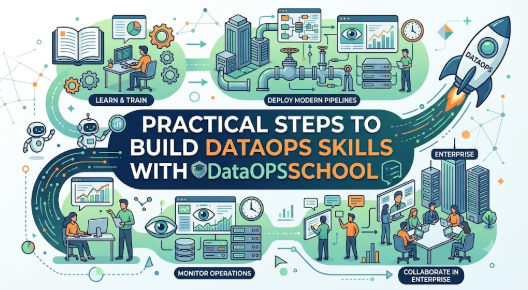
Building proficiency in DataOps requires a structured approach. This eight-step path provides a clear framework for professional development:
Step 1: Fundamentals ---> Step 2: Pipelines ---> Step 3: CI/CD & Automation ---> Step 4: Orchestration
                                                                                        |
Step 8: Implementation <-- Step 7: Certification <-- Step 6: Tool Ecosystems <-- Step 5: Quality & Observability
Step 1: Understand DataOps Fundamentals
Begin by learning core DataOps concepts, focusing on how data lifecycle management differs from traditional software development, and identifying common operational bottlenecks in data workflows.
Step 2: Learn Data Pipeline Basics
Master foundational data movement principles, studying ETL/ELT execution strategies, file format optimizations, schema design, and basic data extraction techniques.
Step 3: Understand Automation and CI/CD for Data
Learn to apply software development practices to data systems. Study version control management, automated test creation for dataset transformations, environment isolation strategies, and deployment scripting.
Step 4: Learn Workflow Orchestration
Examine task scheduling mechanics, dependency graph configurations, parallel job execution concepts, failure handling setups, and automated retry logic.
Step 5: Study Data Quality and Observability
Learn how to insert data validation checks into live workflows, monitor pipeline freshness metrics, analyze runtime execution logs, and trace end-to-end data lineage.
Step 6: Explore DataOps Tools
Familiarize yourself with the main categories in the DataOps tools ecosystem, learning how ingestion platforms, transformation engines, orchestrators, and observability suites interact.
Step 7: Explore Certification Paths
Organize your learning using structured pathways such as the Certified DataOps Engineer track for hands-on pipeline engineering or the Certified DataOps Architect track for system design principles.
Step 8: Apply DataOps Knowledge to Real Data Environments
Put your theoretical knowledge into practice by implementing version control, automated quality testing, clear monitoring, and orchestrated pipelines on real cloud data platforms.
Common Mistakes When Learning or Implementing DataOps
Navigating DataOps adoption can present challenges. Being aware of these common missteps helps engineers and organizations avoid costly implementation mistakes:
- Treating DataOps as Only a Toolset: Purchasing new tools without updating team practices or operational workflows rarely solves underlying operational problems.
- Focusing Solely on Automation: Automating a flawed, unmonitored pipeline simply speeds up the generation of bad data. Automation must be paired with quality checks and monitoring.
- Ignoring Data Quality Checks: Building fast pipelines without automated quality validation leads to downstream reporting errors and damages stakeholder trust.
- Overlooking Observability and Monitoring: Failing to track execution metrics, dataset freshness, and schema drift leaves engineering teams reacting defensively to user bug reports.
- Creating Complex Workflows Without Ownership: Building intricate pipeline dependency trees without clear team documentation or operational ownership leads to maintenance bottlenecks.
- Deploying Changes Without Staging Environments: Testing code modifications directly in production data systems frequently causes unexpected downtime and corrupted datasets.
- Ignoring Governance and Access Controls: Neglecting role-based access rules and data lineage tracking creates security vulnerabilities and compliance issues.
- Expecting Credentials to Replace Practice: Viewing professional certification as a substitute for real-world project execution rather than a structured framework for skill development.
Best Practices for DataOps Learning and Implementation
Adopting these core principles helps technical teams establish reliable, scalable, and manageable data operations:
- Start with High-Value Pipelines: Rather than attempting to overhaul an entire platform at once, apply DataOps principles—such as testing and automated deployments—to a single critical pipeline first.
- Treat Pipeline Logic as Software Code: Store all transformation SQL, orchestration definitions, infrastructure configurations, and test suites in version-controlled repositories.
- Implement Early Data Testing: Validate schema formats, missing value thresholds, and key uniqueness early in the pipeline lifecycle to catch errors before loading target warehouses.
- Maintain Continuous System Visibility: Set up proactive alerting for failed jobs, processing delays, unexpected volume drops, and schema changes.
- Enforce Governance by Design: Integrate access security policies, data lineage tracking, and metadata cataloging directly into automated pipeline steps.
- Document Workflows Clearly: Maintain accurate, accessible documentation covering pipeline dependencies, dataset ownership, schema histories, and operational escalation steps.
Summary Tables: DataOps Core Areas & Platform Offerings
TABLE 1: Primary DataOps Operational Areas
| DataOps Area | What It Covers | Why It Matters |
| Data Pipelines | Mechanisms for moving, loading, and transforming datasets across cloud platforms. | Ensures consistent data transfer from source systems to analytical destinations. |
| ETL / ELT | Architectures for processing and restructuring raw data formats into refined layers. | Prepares unstructured or raw records for business intelligence consumption. |
| CI/CD for Data | Automated code testing, environment isolation, and version-controlled deployment routines. | Prevents broken code updates from damaging production datasets. |
| Workflow Orchestration | Managing execution schedules, complex job dependencies, retries, and task order. | Coordinates multi-step data pipelines efficiently across dispersed platforms. |
| Data Quality | Automated assertions checking field completion, uniqueness, typing, and expected value ranges. | Ensures delivered datasets are accurate, complete, and trustworthy. |
| Data Observability | Tracking system operational health, dataset lineage, processing delays, and schema changes. | Provides early visibility into pipeline issues before end users report them. |
| Monitoring | Logging job execution states, system failures, runtime durations, and operational errors. | Provides real-time operational feedback to on-call engineering teams. |
| Data Governance | Access permissions management, compliance tracking, policy enforcement, and cataloging. | Protects sensitive information while ensuring regulatory and operational compliance. |
| Cloud Data Platforms | Scalable warehouse and lake infrastructure hosting large-scale dataset analytics. | Delivers elastic compute and storage capacity for modern enterprise data. |
| Automation | Replacing manual execution routines with event-based or scheduled code processes. | Reduces human error, speeds delivery times, and stabilizes system operations. |
TABLE 2: DataOpsSchool Offerings Matrix
| DataOpsSchool Offering | Main Focus | Suitable For |
| DataOps Training | Practical instruction in automation, testing, orchestration, and pipeline operations. | Engineers seeking hands-on operational skills for modern data environments. |
| DataOps Course | A structured learning pathway covering data principles from basics to advanced setups. | Learners who prefer sequential, comprehensive skill progression. |
| DataOps Tutorial | Self-paced, topic-focused guides addressing specific technical configurations. | Working engineers who need immediate help with targeted operational concepts. |
| DataOps Certification | Structured skill assessment evaluating mastery of core operational practices. | Professionals wanting to validate their technical knowledge systematically. |
| Certified DataOps Engineer | Technical evaluation focusing on pipeline code, CI/CD routines, and quality testing. | Data engineers, pipeline developers, and technical automation specialists. |
| Certified DataOps Architect | Assessment focusing on system platform design, governance, security, and scalability. | Senior architects, lead data engineers, and technical strategy directors. |
| DataOps Consulting | Strategic assessment, workflow auditing, and architecture planning services. | Organizations seeking expert guidance to modernize fragile data systems. |
| DataOps Services | Direct implementation support for platform automation, observability, and testing. | Enterprises looking to optimize pipeline reliability and operational efficiency. |
Benefits of Learning DataOps
Mastering data operations practices offers clear advantages for technical professionals and engineering teams:
- Deeper Understanding of Data Systems: Develops a clear, end-to-end perspective on how data flows from source applications to downstream reporting platforms.
- Improved System Automation Skills: Teaches engineers how to replace manual processing scripts with robust, event-driven pipelines.
- Stronger Focus on System Reliability: Helps technical practitioners build fault-tolerant architectures that handle bad input records gracefully without failing completely.
- Proactive Data Quality Practices: Shift quality validation from an afterthought to an integrated step within live data pipelines.
- Clearer Operational Visibility: Practical observability knowledge makes tracking pipeline issues, schema changes, and execution delays far more straightforward.
- Better Technical Alignment across Teams: Connects core data engineering practices with DevOps deployment strategies, improving cross-team collaboration.
- In-Demand Architectural Insights: Provides high-level perspectives on selecting tool categories, setting up governance controls, and scaling infrastructure cleanly.
DataOps Certification and Career-Focused Learning
As organizations increasingly depend on real-time data delivery, demand for engineers who understand both data architecture and operational reliability continues to grow.
Participating in structured certification pathways, such as those offered by DataOpsSchool, helps technical professionals focus their learning around practical industry concepts. Rather than studying tools in isolation, certification paths guide learners to treat data environments as integrated systems that require version control, automated testing, orchestration, observability, and clear governance.
- For Mid-Level Engineers: The Certified DataOps Engineer approach emphasizes practical operational skills—such as pipeline automation, setting up staging tests, managing orchestration tasks, and configuring monitoring alerts.
- For Senior Professionals: The Certified DataOps Architect track focuses on enterprise architecture decisions, governance enforcement across distributed cloud layers, platform scalability, security policies, and tool stack integration.
Ultimately, combining formal learning and structured certifications with practical, real-world project execution helps engineers build flexible, resilient skills that adapt as technologies evolve.
DataOps Consulting and Services for Organizations
Growing organizations often encounter operational hurdles with their data platforms. Common signals that an enterprise could benefit from specialized DataOps Consulting or technical services include:
How Professional DataOps Services Assist Companies
- Operational Audits: Evaluating existing data workflows to identify manual bottlenecks, fragile processing steps, missing validation tests, and governance gaps.
- Automation Planning: Designing clear roadmaps to replace manual scripts with version-controlled, automated pipelines and isolated staging environments.
- Observability Implementation: Setting up monitoring platforms that track pipeline health, execution delays, dataset freshness, and schema modifications in real time.
- Data Quality Integration: Inserting automated test assertions directly into ETL/ELT pipelines to flag bad data before it impacts business dashboards.
- Governance and Scalability Design: Constructing frameworks for role-based access management, metadata tracking, and audit-ready data lineage across multi-cloud infrastructure.
Through these professional services, platforms like DataOpsSchool help enterprises convert high-maintenance, fragile data setups into reliable, highly automated data platforms.
DataOps for Different Professional Roles
Understanding data operations benefits various engineering disciplines, with each role focusing on different technical applications:
Data Engineers
- Primary Focus: Building reliable pipelines, configuring automated ETL/ELT workflows, writing dataset unit tests, and optimizing execution efficiency.
- DataOps Impact: Reduces midnight pipeline troubleshooting by catching schema changes and missing data fields automatically.
DevOps Engineers
- Primary Focus: Managing CI/CD build environments, automating infrastructure provisioning, tracking service metrics, and maintaining system uptime.
- DataOps Impact: Extends proven software engineering release controls and infrastructure-as-code deployment practices to data infrastructure.
SRE Professionals
- Primary Focus: System stability, service-level indicators (SLIs), incident management protocols, and runtime reliability.
- DataOps Impact: Treats data health metrics and pipeline delays as key system performance indicators, establishing proactive operational alerts.
Analytics Engineers
- Primary Focus: Building modular SQL transformation models, maintaining data documentation, and managing analytical data structures.
- DataOps Impact: Ensures transformation models undergo rigorous automated testing and version management before updating analytical views.
Cloud Professionals
- Primary Focus: Cloud resource provisioning, storage allocation, access policy configuration, and computing cost management.
- DataOps Impact: Improves resource visibility, automates multi-environment deployments, and ensures security policy compliance across data platforms.
Architects
- Primary Focus: Designing end-to-end system architectures, selecting appropriate tool stacks, defining governance policies, and planning long-term scalability.
- DataOps Impact: Establishes resilient, scalable, and audit-friendly system architectures that accommodate evolving technical requirements smoothly.
Frequently Asked Questions
1. What is DataOps in simple terms?
DataOps is an operational framework that adapts modern software engineering practices—such as automation, testing, CI/CD, and monitoring—to data pipelines. Its goal is to make data delivery faster, more accurate, and far more reliable.
2. Who should learn DataOps concepts?
Data engineers, DevOps engineers, SREs, analytics engineers, cloud architects, and technology managers who build, maintain, or rely on production data pipelines can all benefit from learning DataOps.
3. What does DataOps Training typically focus on?
DataOps training focuses on practical skills such as pipeline automation, continuous testing, workflow orchestration, version control for data code, observability monitoring, and governance frameworks.
4. How can a DataOps Course help data engineers in their day-to-day work?
A structured course provides a clear learning path, showing engineers how to transition from building manual, fragile scripts to designing automated, resilient pipelines that handle unexpected schema changes and bad data smoothly.
5. What can learners expect to study in a DataOps Tutorial?
A DataOps tutorial generally focuses on a specific, hands-on task—such as writing automated data quality checks, configuring pipeline orchestrators, setting up staging environments, or logging pipeline alerts.
6. What is the purpose of DataOps Certification?
Certification provides a structured roadmap for professional learning. It allows engineers to systematically assess and showcase their understanding of data operations, pipeline automation, and platform design.
7. What does a Certified DataOps Engineer focus on?
A Certified DataOps Engineer focuses on practical operational tasks—including pipeline code development, automated ETL/ELT transformations, quality test configurations, CI/CD routines, and pipeline monitoring.
8. How does a Certified DataOps Architect role differ from a DataOps Engineer?
While an engineer focuses on pipeline code and daily operations, an architect focuses on higher-level platform design—including end-to-end system architecture, tool selection, governance frameworks, multi-cloud scalability, and enterprise security policies.
9. What categories of DataOps Tools are commonly used?
Key tool categories include ingestion platforms, transformation frameworks, workflow orchestrators, CI/CD engines, data quality validation tools, observability platforms, cloud storage platforms, and governance catalogs.
10. When should an organization consider DataOps Consulting or professional services?
An enterprise should consider consulting services when facing frequent pipeline failures, manual operational bottlenecks, low stakeholder confidence in data reports, unclear system failure visibility, or difficulties scaling infrastructure safely.
Conclusion
Modern businesses rely on data to make critical operational decisions every day. However, without systematic engineering practices, growing data environments can quickly become fragile, slow, and prone to error. DataOps solves these challenges by combining pipeline automation, continuous testing, orchestration, observability, and clear governance into a unified operational methodology.
Adopting DataOps requires moving beyond seeing data management as merely a collection of isolated tools. It demands a holistic approach focused on pipeline reliability, rapid iteration, clear system visibility, and automated quality controls. Whether through self-paced tutorials, structured training courses, professional certification pathways, or enterprise consulting services, platforms like DataOpsSchool provide the educational and technical support engineers and organizations need to build resilient, reliable, and scalable modern data operations.
Leave a Reply