SRE Certification & Training: Your Roadmap to High-Availability Systems
Introduction
Modern software applications must run 24 hours a day, 7 days a week. When a popular website or mobile app crashes, millions of users notice immediately, and businesses lose money. Managing these complex cloud systems is a massive challenge.
Traditional IT operations often rely on manual work and urgent fixes when things break. Site Reliability Engineering changes this approach by treating operations as a software problem.
Many beginners find SRE confusing because it mixes software development, system administration, and automation. Without proper guidance, teams spend all their time reacting to emergencies instead of building better software.
This guide explains what SRE is, why it matters, and how structured training can help you build a successful career as an SRE Engineer.
What Is Site Reliability Engineering?
Site Reliability Engineering is a discipline created to help organizations run large-scale systems reliably.
The Simple Meaning
An SRE engineer uses coding and automation to keep computer systems running smoothly. Instead of manually restarting servers or fixing broken networks by hand, an SRE writes programs to do these tasks automatically.
Why It Matters
As software grows larger, human beings cannot manage every server and database manually. SRE bridges the gap between software developers who write code and operations teams who run systems. It ensures that new features launch quickly without crashing the entire platform.
How SRE Works
SRE relies on specific principles to measure and improve system health. Understanding these core concepts is the foundation of any good SRE Tutorial.
1. Service Level Indicators (SLIs)
An SLI is a metric that measures how well a system is performing. For example, it might measure how fast a webpage loads or whether a login button works properly.
2. Service Level Objectives (SLOs)
An SLO is the target goal for your system performance. If your SLI measures webpage speed, your SLO might state that 99 percent of pages must load in under two seconds.
3. Error Budgets
An error budget is the amount of downtime a system is allowed to have over a specific period. If your SLO is 99.9 percent uptime, your error budget allows for a tiny fraction of failures. This budget helps teams balance speed and stability. When the budget is healthy, developers can release new features quickly. When the budget runs out, the team focuses entirely on fixing reliability issues.
Important SRE Tools and Technologies
To do their jobs effectively, engineers must master various SRE Tools. These tools fall into several key categories:
- Monitoring and Observability: Tools like Prometheus, Grafana, and Datadog track system health, CPU usage, and error rates in real-time.
- Infrastructure Management: Tools like Terraform and Ansible allow engineers to set up servers and networks using configuration code rather than manual clicking.
- Containerization and Orchestration: Kubernetes and Docker help package applications so they run smoothly across different cloud environments.
- Incident Management: Platforms like PagerDuty alert the right engineers when a system failure occurs.
Proven SRE Best Practices
Following established SRE Best Practices helps teams prevent major outages and recover quickly when problems happen.
- Automate Repetitive Tasks: If a human has to do the same manual server check every single day, write a script to automate it.
- Practice Blameless Post-Mortems: When an outage happens, focus on fixing the broken process or code rather than blaming individual team members.
- Test for Failure: Use engineering techniques to intentionally break parts of a system in a safe environment. This proves whether your backup systems work as expected.
- Keep Changes Small: Deploying small updates frequently makes it much easier to find and fix bugs than releasing massive updates all at once.
Practical Examples in the Real World
Example: The E-Commerce Checkout Crash
Imagine an online clothing store during a major holiday sale. Millions of shoppers visit the site at the same time.
- Without SRE: The database gets overloaded, the payment page crashes, and customers cannot buy anything. The IT team scrambles to reboot servers manually while losing thousands of dollars every minute.
- With SRE: The engineering team set up automatic scaling using Kubernetes so the system adds more servers when traffic spikes. They also set up alerts so that if payment failures cross a tiny threshold, an on-call engineer is notified instantly before the entire store goes offline.
Common Mistakes Beginners Make
- Treating SRE Like Standard IT Support: SRE is not just about answering help tickets. It is about writing software to eliminate operational problems permanently.
- Ignoring Software Development: SRE requires coding skills. Trying to master SRE without learning basic programming will limit your career growth.
- Setting Unrealistic SLOs: Promising 100 percent uptime is impossible. Even major cloud providers experience brief interruptions. Aim for realistic goals based on user needs.
Risks and Limitations
While SRE brings massive improvements, organizations must consider its limitations:
- High Skill Requirement: Finding experienced SRE professionals can be difficult and expensive.
- Cultural Resistance: Traditional development teams may resist sharing operational responsibilities with SREs.
- Initial Setup Cost: Building robust automation and observability takes time before you see a return on investment.
SRE Training and Certification Path
If you want to build a career in this field, structured learning is essential.
SRE Training Programs
Comprehensive Site Reliability Engineering Training covers everything from basic Linux commands to advanced cloud architecture and incident response. Programs like those at SRESchool.in provide clear learning paths for both beginners and experienced engineers.
SRE Certification
Earning a recognized Site Reliability Engineering Certification proves your knowledge to employers. It validates your ability to manage production systems, handle incidents, and implement automation correctly.
SRE Course Structure
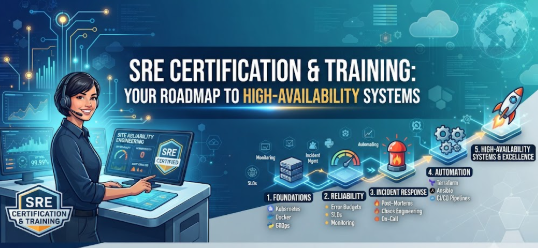
A standard learning path includes:
- Foundations: Linux, networking, and basic scripting.
- Core Concepts: SLIs, SLOs, and error budgeting.
- Operations: Monitoring, logging, and tracing.
- Automation: Infrastructure as code and CI/CD pipelines.
Decision Framework: Is SRE Right for You?
Use this simple framework to decide your next steps in reliability engineering:
- Assess Your Background: Do you enjoy coding, troubleshooting, and understanding how large software systems connect?
- Identify Your Gaps: Do you need help with cloud tools, Kubernetes, or automation?
- Choose Structured Learning: Enroll in a guided SRE Course rather than trying to piece together random tutorials online.
- Practice Hands-On: Build small labs, set up monitoring tools, and automate simple tasks in a test environment.
Checklist for Aspiring SRE Engineers
- Learn basic programming (Python or Go).
- Understand Linux operating systems and computer networking.
- Study core SRE principles like error budgets and SLOs.
- Gain hands-on experience with monitoring tools like Prometheus.
- Learn infrastructure automation using Terraform.
- Enroll in a recognized SRE Training program to validate your skills.
Key Terms
- Automation: Using software scripts to perform tasks without human intervention.
- Availability: The percentage of time that a system is operational and accessible to users.
- CI/CD: Continuous Integration and Continuous Deployment; practices for automating software releases.
- Incident Response: The structured process a team follows to handle and resolve unexpected system outages.
- Observability: The ability to measure the internal state of a system by examining its outputs, logs, and metrics.
- Scalability: The ability of a system to handle growing amounts of work by adding resources.
- Telemetry: Automated collection of data from remote devices and systems for monitoring.
Frequently Asked Questions
What is the difference between DevOps and SRE?
DevOps is a cultural philosophy focused on breaking down barriers between development and operations teams. SRE is a specific implementation of that philosophy, often treated as software engineering applied to operations.
Do I need to know how to code to become an SRE?
Yes. SRE engineers write code to automate tasks, build monitoring tools, and fix system failures. Familiarity with languages like Python or Go is very helpful.
How long does it take to complete an SRE course?
The timeline depends on your current IT experience. Beginners typically take several months of dedicated study, while experienced system administrators may transition faster.
Is SRE Training suitable for beginners?
Yes, provided the training starts with foundational concepts like Linux and networking before moving into advanced production engineering.
What career opportunities open up after SRE Certification?
Certified professionals can work as Site Reliability Engineers, DevOps Engineers, Cloud Infrastructure Engineers, and Production Support Leads.
Conclusion
Building and maintaining reliable software systems is one of the most important challenges in modern technology. By mastering core principles, using the right automation tools, and pursuing structured SRE Training, you can help organizations deliver dependable digital experiences. Whether you are starting fresh or leveling up your IT career, understanding Site Reliability Engineering provides a strong foundation for long-term professional success.
Leave a Reply